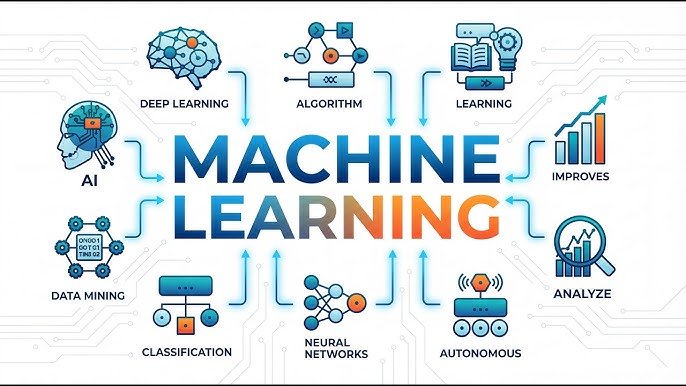
In the modern digital world, Machine Learning (ML) has become one of the most important technologies driving innovation. From personalized recommendations on streaming platforms to advanced medical diagnostics, machine learning is transforming how businesses and industries operate.
Machine learning is a branch of artificial intelligence that allows computers to learn from data and improve their performance without being explicitly programmed. As data continues to grow exponentially, machine learning is becoming essential for analyzing information and making intelligent decisions.
Machine learning is a technology that enables computers to learn patterns from data and make predictions or decisions automatically. Instead of following fixed instructions, machine learning systems improve their performance by analyzing large datasets.
For example, when you shop online, recommendation systems analyze your past purchases and browsing behavior to suggest products you might like. These recommendations are powered by machine learning algorithms.
Machine learning systems use mathematical models and algorithms to identify patterns in data and generate insights that help businesses and organizations make better decisions.
Machine learning can generally be divided into three main types.
Supervised learning involves training a model using labeled data. This means the input data already includes the correct output.
For example, email spam filters use supervised learning to classify emails as spam or not spam based on previous labeled examples.
Unsupervised learning works with data that has no labeled outputs. The system identifies patterns and relationships within the data.
This technique is often used in customer segmentation, recommendation systems, and anomaly detection.
Reinforcement learning focuses on learning through trial and error. The system receives rewards or penalties based on its actions and gradually improves its performance.
This method is widely used in robotics, gaming AI, and autonomous vehicles.
Machine learning is already being used in many industries to improve efficiency and innovation.
Machine learning helps doctors analyze medical images, detect diseases earlier, and predict patient outcomes more accurately.
Banks and financial institutions use machine learning to detect fraudulent transactions, analyze risks, and automate investment strategies.
Online shopping platforms use machine learning algorithms to recommend products, analyze customer behavior, and improve user experience.
Self-driving cars use machine learning to analyze sensor data, detect obstacles, and make real-time driving decisions.
Businesses use machine learning to analyze customer preferences, personalize advertisements, and optimize marketing strategies.
Machine learning offers several advantages that make it valuable for organizations.
Automation of complex tasks – ML systems can automate repetitive and data-intensive processes.
Improved decision-making – By analyzing large datasets, ML models provide valuable insights for better decisions.
Personalized experiences – Companies can deliver personalized recommendations and services.
Predictive capabilities – ML systems can predict trends, customer behavior, and future outcomes.
Despite its many benefits, machine learning also has certain challenges.
Organizations must carefully design and monitor machine learning systems to overcome these challenges.
Machine learning is expected to play a major role in the future of technology. As computing power and data availability continue to grow, machine learning systems will become more powerful and widely used.
Industries such as healthcare, education, finance, and transportation will continue to adopt machine learning solutions to improve efficiency and innovation.
In the coming years, machine learning will also work closely with technologies like artificial intelligence, big data, and cloud computing to create smarter digital systems.
Machine learning is transforming the way we interact with technology. By enabling computers to learn from data and improve automatically, it is helping organizations solve complex problems and deliver better services.
As technology continues to evolve, machine learning will remain at the center of innovation, shaping the future of industries and digital experiences.
.png)