
In today’s competitive digital landscape, businesses must deliver software faster, more reliably, and with higher quality. Traditional development models often struggle to meet these demands due to slow release cycles and inefficient collaboration between teams.
This is where DevOps and automation come into play. By integrating development and operations teams and automating repetitive processes, DevOps enables organizations to build, test, and deploy applications at a much faster pace.
In this guide, we will explore what DevOps and automation are, how they work, their benefits, and why they are essential for modern software development.
DevOps is a modern software development approach that combines software development (Dev) and IT operations (Ops) into a unified workflow. The primary goal of DevOps is to improve collaboration between teams and accelerate the software delivery process.
Traditionally, developers wrote code while operations teams handled deployment and infrastructure. This separation often caused delays and communication issues. DevOps eliminates these barriers by encouraging continuous collaboration, integration, and feedback.
DevOps is built on several key principles:
Collaboration: Developers and operations teams work together throughout the entire lifecycle.
Continuous Integration (CI): Code changes are frequently integrated into a shared repository.
Continuous Deployment (CD): Automated deployment of applications to production.
Automation: Repetitive processes such as testing and deployment are automated.
Monitoring and feedback: Continuous system monitoring helps teams detect and fix issues quickly.
These practices help organizations deliver high-quality software faster and more reliably.
Automation in DevOps refers to the use of tools and technologies to automatically perform tasks that would otherwise require manual intervention.
Automation is a critical component of DevOps because it improves efficiency, reduces human errors, and ensures consistency across environments.
Automation is applied across several stages of the development lifecycle, including:
Automated testing – Running tests automatically whenever code changes occur
Automated builds – Compiling and packaging code automatically
Automated deployments – Delivering applications to servers without manual steps
Infrastructure provisioning – Creating infrastructure using code
Monitoring and alerting – Automatically tracking system performance
By automating these tasks, teams can focus more on innovation rather than repetitive operational work.
Automation and continuous integration pipelines allow organizations to release updates and new features much faster. Businesses can respond quickly to market demands and customer feedback.
DevOps breaks down traditional silos between development and operations teams. This collaborative environment improves communication and increases productivity.
Automated testing ensures that code is consistently tested before deployment, reducing bugs and improving application stability.
Manual processes often introduce configuration mistakes. Automation ensures consistency and reduces the chances of errors during deployment.
Automation allows organizations to scale infrastructure efficiently. Applications can handle increased traffic and workloads without significant manual effort.
DevOps includes real-time monitoring and analytics, helping teams detect performance issues early and continuously improve their systems.
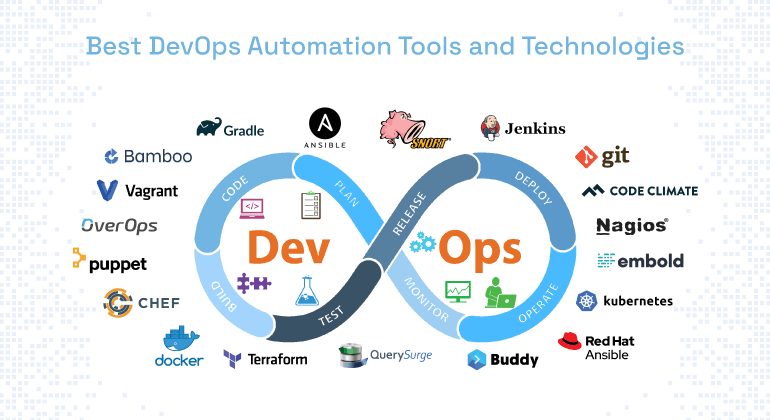
Several tools are widely used to implement DevOps and automation successfully.
A popular automation server used for continuous integration and continuous delivery (CI/CD).
A containerization platform that allows developers to package applications with all dependencies into portable containers.
An orchestration platform used to manage and scale containerized applications.
A powerful automation tool used for configuration management and application deployment.
An Infrastructure as Code (IaC) tool that allows developers to manage infrastructure through code.
A version control system that helps teams track changes and collaborate efficiently on code.
These tools form the backbone of many modern DevOps pipelines.
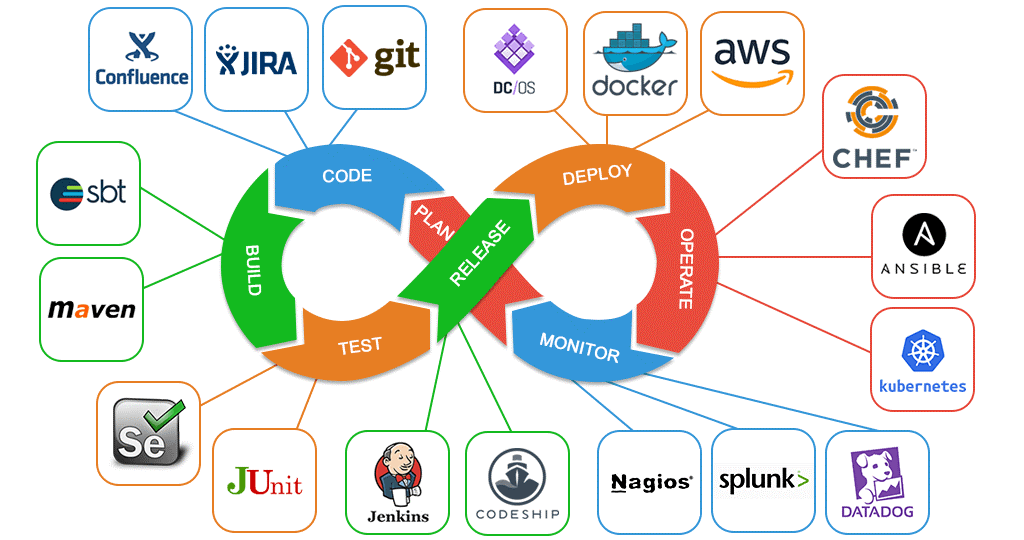
The DevOps lifecycle consists of several interconnected stages that support continuous development and delivery.
Defining project goals, requirements, and development strategies.
Writing and managing application code using version control systems.
Compiling code and creating executable packages.
Running automated tests to ensure software quality.
Preparing the application for deployment.
Deploying the application to production environments.
Managing infrastructure and ensuring system stability.
Tracking system performance and gathering feedback for improvements.
Automation plays a vital role in nearly every stage of this lifecycle.
DevOps and automation are revolutionizing how modern software is developed, tested, and deployed. By integrating teams, automating processes, and enabling continuous delivery, organizations can achieve faster releases, improved reliability, and better scalability.
Businesses that embrace DevOps today will be better positioned to innovate, adapt, and succeed in the rapidly evolving digital world.
.png)